 listicle
Affordable Fishing Charters in Bradenton Beach: 2026 Guide
Table of Contents
- Quick Comparison: Affordable Fishing Charters Near Bradenton Beach
- Inshore vs. Offshore: Which Trip Type Fits Your Budget?
- Half-Day vs. Full-Day Fishing Charter: Which Is Worth It?
- What to Bring on a Fishing Charter Checklist
- Fishing Charter Tipping Guide: What to Budget
- Splitting Costs: Group and Shared Charter Logistics
- Licensing, Regulations, and Seasonal Species Calendar
- Conclusion
- Frequently Asked Questions
Last Updated: September 10, 2026
Quick Comparison: Affordable Fishing Charters Near Bradenton Beach
Finding affordable fishing charters in Bradenton Beach comes down to matching trip type, group size, and duration to your budget. This guide from Little Philly Sea Adventures breaks down what each option costs in time and money.
The Gulf Coast around Anna Maria Island offers some of Florida's most accessible saltwater fishing. You don't need a luxury budget, just a clear picture of how charter pricing works before you book.
Below, we'll show you how to compare trip types, split costs with a group, and avoid hidden fees that catch first-timers off guard.
Inshore vs. Offshore: Which Trip Type Fits Your Budget?
Inshore and nearshore trips cost significantly less than offshore excursions because they burn less fuel and travel shorter distances. For budget-conscious anglers, inshore delivers the best value per hour on the water.
Inshore and Nearshore Trips
Inshore fishing keeps you in bays, estuaries, and coastal waters within a few miles of shore, targeting snook, redfish, trout, and tarpon in the mangroves and flats around Tampa Bay and the Manatee River.
A common mistake is assuming inshore means small fish, light tackle charters regularly land trophy snook and redfish. The tradeoff is species variety: no grouper or amberjack in two feet of water.
Offshore and Deep Sea Excursions
Offshore and deep sea charters run further into the Gulf of Mexico, targeting grouper, snapper, kingfish, cobia, and amberjack. They cost more because they burn more fuel and require larger, sturdier boats.
For a group splitting costs, offshore can still fit a moderate budget. The key is maximizing your headcount.
Half-Day vs. Full-Day Fishing Charter: Which Is Worth It?
A half-day trip runs about 4 hours in inshore or nearshore waters; a full-day charter runs 6 to 10 hours and reaches deeper offshore grounds. For most first-timers and families, half-day offers the best balance of experience and value.
Here's how the two compare:
| Trip Type | Typical Duration | Best For | Budget Impact |
|---|---|---|---|
| Half-day | 3-4 hours | Families, beginners, inshore | Lower cost, less fuel |
| Full-day | 6-10 hours | Serious anglers, offshore | Higher cost, more species |
The half-day vs full-day fishing charter decision usually comes down to stamina and goals. Young kids tire fast on the water. Serious anglers chasing grouper want the extra hours to reach productive reefs.
What to Bring on a Fishing Charter Checklist
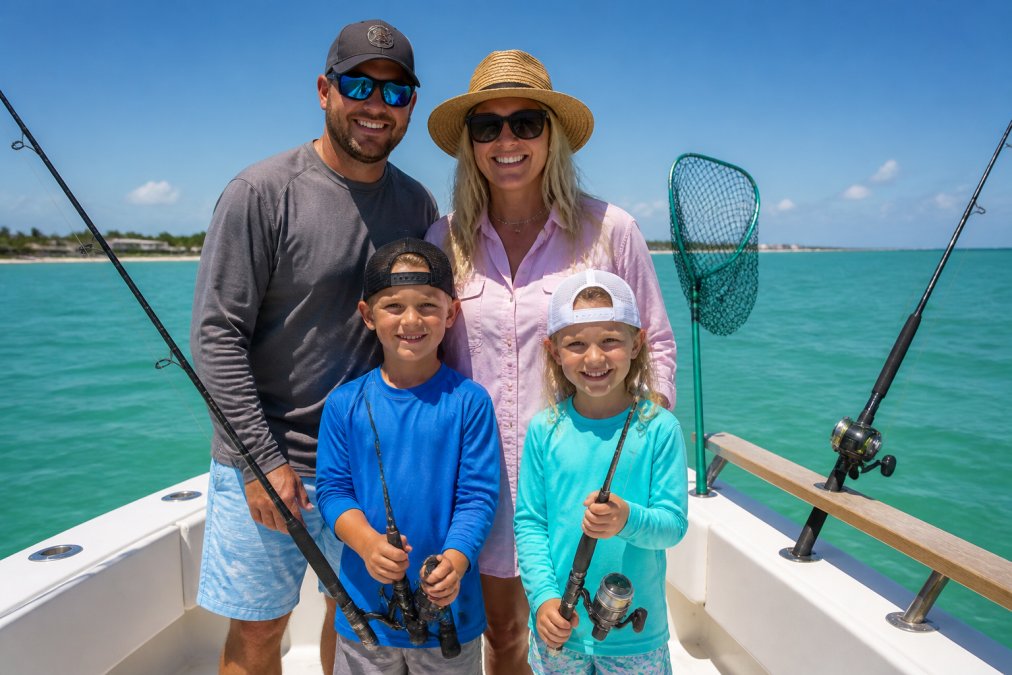
A good captain supplies rods, reels, bait, and tackle. Your job is the personal items that make the day comfortable, pack light, but don't skip the essentials.
Use this what to bring on a fishing charter checklist:
- Sunscreen (reef-safe, SPF 30 or higher)
- Polarized sunglasses to cut glare and spot fish
- Hat and light long-sleeve shirt for sun protection
- Non-marking soft-soled shoes
- Reusable water bottle and snacks
- Motion sickness medication taken before departure
- A small cooler for drinks and your catch
- Towel and a change of clothes
- Valid fishing license if required for your trip
Fishing Charter Tipping Guide: What to Budget
A fishing charter tipping guide starts with one rule: tip your captain and crew for effort and service, not catch size. Industry custom runs 15 to 20 percent of the trip cost for good service.
Tips reward the work you don't see. Your captain scouts fish, handles the boat, and often cleans your catch. Deckhands rig lines, bait hooks, and keep everyone safe.
Set aside the tip before you book so the final cost won't surprise you. If a captain works hard to put you on fish on a slow day, that effort deserves recognition.
Splitting Costs: Group and Shared Charter Logistics
Splitting a private charter across a group lowers each person's share dramatically, while shared charters booked per seat offer the lowest entry point for solo travelers and couples. The mechanics are where the real savings live.
How Private Charter Splitting Works
A private charter is a flat rate for the boat, not per person. The captain sets a maximum headcount (often by the vessel's Coast Guard certificate), and you divide the total by however many people show up.
- A private charter has a flat rate. Divide it by your headcount for the per-person cost.
- A shared charter charges per seat. You fish alongside other guests you did not bring.
- Larger groups get the best per-person value on private trips, up to the boat's legal capacity.
The practical move: fill every seat the boat is licensed to carry. If a boat is rated for six and you bring four, you still pay the flat rate, recruiting two more people cuts each share by roughly a third.
How Shared or "Split" Charters Actually Work
A shared charter (also called a split charter or open boat) sells individual seats on a scheduled trip. You pay per person, show up at the dock, and fish with other guests and a mate or deckhand.
What to expect on a shared trip:
- Per-seat pricing. You pay only for your spot, which is why this is the cheapest way for one or two people to get offshore.
- Set schedule. Departure times are fixed by the operator, not by you.
- Shared rail space. You rotate spots or fish a designated position along the rail.
- Common catch rules. The captain decides how the day's catch is divided, so ask before you book whether it is split evenly, kept by the angler who hooked it, or pooled.
- Minimum headcount. Many operators will not run a shared trip unless a minimum number of seats is booked, so confirm the trip is a "go" before you drive to the dock.
The Cost Math, Side by Side
Here is the decision framework budget-conscious anglers should run before booking:
| Scenario | Who Pays What | Best For |
|---|---|---|
| Private, full boat | Flat rate split evenly across max headcount | Groups of 4-6 who can fill seats |
| Private, half-full boat | Flat rate split across fewer people | Small groups who want privacy and accept higher per-person cost |
| Shared, per seat | Each person pays one seat price | Solo travelers, couples, budget-first anglers |
| Shared, minimum not met | Trip may cancel or rebook | Anyone with a tight schedule |
For a group that can fill a boat, a private charter split evenly usually beats individual shared-charter rates, and you control the itinerary and departure time. For one or two people, the shared seat is almost always cheaper.
Trade-Offs Nobody Mentions
Splitting costs involves compromises. Weigh these before you commit:
- Privacy vs. price. A shared boat means strangers, shared rail space, and a captain balancing multiple guests' goals.
- Itinerary control. On a shared trip you go where the majority and the captain decide. On a private trip, you set the target species and the pace.
- Catch division. On shared trips, confirm how the catch is split. On private trips, the catch is yours.
- Flexibility. Private trips let you shift dates for weather or fish movement. Shared trips run on the operator's schedule.
- Tipping. Tips apply on both, but on a shared trip you tip per seat, not per boat.
If you are booking a shared charter, ask two questions before you pay: "Is this trip guaranteed to run?" and "How is the catch divided?" Those two answers prevent most of the friction budget travelers run into.
The cheapest trip is rarely the best value. A slightly higher rate that includes fish cleaning, quality tackle, and an experienced captain usually saves you money and frustration. The best budget move is filling seats, not shaving the rate.
Licensing, Regulations, and Seasonal Species Calendar
Two things trip up budget-conscious anglers most: assuming they need a license when the boat already covers them, and booking a trip for an out-of-season species. Both are easy to get right once you know the rules.
Do You Need a Fishing License on a Charter?
In Florida, if you fish from a vessel whose operator holds the required recreational fishing license coverage, passengers are generally covered and don't need their own license, one of the quiet savings of booking a charter (myfwc.com).
What to confirm before you book:
- Ask the operator directly: "Does your license cover all passengers?" Most charter captains carry coverage for everyone aboard, but confirm it in writing.
- Shore fishing is different. If you plan to fish from a pier, bridge, or the beach on your own, you likely need your own license.
- Buying your own. If you do need one, short-term and annual resident and nonresident licenses are available through the Florida Fish and Wildlife Conservation Commission.
- Keep proof. Carry your license or confirmation on your phone if you buy your own.
Regulations That Affect Your Trip
Regulations protect fish populations and change by species and season. Snook, redfish, and tarpon have specific size and bag limits, and some species have closed seasons. A few things budget anglers should know:
- Bag and size limits vary by species. Your captain will know current rules, but it helps to understand them so you are not surprised when a keeper goes back.
- Some species are catch-and-release only during certain windows.
- Rules change. Check current rules through the Florida Fish and Wildlife Conservation Commission before your trip rather than relying on an old blog post.
- Your captain is your best source. Regulations are updated regularly, and a licensed captain tracks them daily.
Month-by-Month Species Calendar
Here is a more useful breakdown of what is typically productive in Gulf waters off the central west coast. Timing varies with water temperature and weather, so treat this as a planning guide, not a guarantee.
| Month | Prime Targets | Notes |
|---|---|---|
| January | Sheepshead, trout | Cool-water inshore; sheepshead stack on structure |
| February | Sheepshead, trout, redfish | Similar to January; redfish active on flats |
| March | Snook, redfish, trout | Spring transition begins; inshore action builds |
| April | Snook, redfish, trout, cobia | Cobia start showing nearshore |
| May | Tarpon, snook, redfish | Tarpon arrive; early-season giants |
| June | Tarpon, snapper, shark | Tarpon peak; nearshore snapper strong |
| July | Tarpon, snapper, shark | Warm-water peak; early and late trips beat the heat |
| August | Tarpon, snapper, shark | Similar to July; watch afternoon storms |
| September | Redfish, snook, kingfish | Fall migration begins |
| October | Redfish, kingfish, cobia | Strong nearshore runs |
| November | Redfish, trout, sheepshead | Cooling water pushes fish inshore |
| December | Sheepshead, trout, grouper | Offshore stays productive in cooler months |
How to Use This Calendar to Save Money
Timing is a budget lever, not just a fishing lever:
- Book shoulder months. Late spring and early fall often combine good action with better availability and rates than peak summer.
- Match your target to the month. Chasing tarpon in January wastes a trip. Chasing sheepshead in July does the same.
- Ask before you book. Your captain tracks these patterns daily. Ask what is biting before you book so your expectations match reality.
- Weekday trips. Midweek departures frequently have more availability and sometimes better rates than weekends.
Do not assume a species is legal to keep just because it is biting. Bag limits, size limits, and closed seasons change, and a captain who follows the rules may release a fish you expected to keep. Confirm the rules for your target species before you book.
Conclusion
Choosing the right charter without overspending takes a little planning, but the payoff is a day on the water you'll remember. Little Philly Sea Adventures makes that easy with a no surprises policy, transparent booking, and premium Gulf Coast fishing charters serving Holmes Beach and Anna Maria Island. Our team provides the equipment and local expertise so you can focus on the catch, not the fine print.
Frequently Asked Questions
How much do fishing charters typically cost in the Bradenton Beach area?
Pricing for affordable fishing charters in Bradenton Beach depends on trip length, group size, and whether you choose a private or shared boat. Shared party boats often charge per person, while private charters are priced per trip. Little Philly Sea Adventures does not list fixed rates online because costs vary by season and itinerary. Contact them directly for a transparent quote with no hidden fuel or tax surprises.
What is the standard tipping etiquette for a fishing charter captain?
A fishing charter tipping guide commonly suggests 15 to 20 percent of the trip cost for the captain and crew, especially if they helped you find fish, baited hooks, and cleaned your catch. Bring cash, as many captains cannot add gratuity to a card payment. Tipping is not mandatory but is appreciated for good service.
Are there affordable options for family-friendly fishing charters near Anna Maria Island?
Yes. Several operators in the Bradenton Beach area offer family-friendly trips that welcome children. These charters focus on inshore waters with calm conditions and light tackle, making it easy for kids to reel in snapper, trout, or ladyfish. Shared party boats are often the most budget-friendly choice for families, while private charters give you more flexibility and personalized attention from the captain.
What should I bring on a half-day fishing charter?
A what to bring on a fishing charter checklist for a half-day trip should include sunscreen, a hat, sunglasses, and weather-appropriate clothing. Bring snacks and plenty of water, plus a cooler if you plan to keep your catch. Many captains supply bait and tackle, but confirm ahead of time. A Florida saltwater fishing license is required for anyone 16 and older fishing from a private vessel, though licensed charter captains typically cover their passengers.
How do I split costs for a group fishing charter?
For groups of six to eight, booking a private charter and splitting the total by head often costs less per person than individual shared-trip rates. Ask the captain for a flat-rate quote that includes fuel, bait, and taxes so you can divide the final number evenly. Little Philly Sea Adventures follows a no surprises policy, meaning you know the full cost before you commit, which makes splitting among friends straightforward.
Book your unforgettable experience today with Little Philly Sea Adventures. Get started and enjoy a transparent, hassle-free fishing adventure on the Gulf Coast.