 how-to
Jet Ski Safety Tips for Beginners: 7 Essential Steps
Table of Contents
- Why Jet Ski Safety Matters for First-Time Riders
- Essential Safety Gear: Jet Ski Life Jacket Requirements
- Pre-Ride Equipment Inspection Checklist
- Understanding Throttle Control and Steering Mechanics
- How to Turn a Jet Ski Without Falling: Technique and Practice
- What to Expect From a Jet Ski Rental Safety Briefing
- Water Conditions, Navigation Rules, and Hazard Awareness
- Fall Recovery and Re-Boarding Techniques
Last Updated: August 29, 2026
Why Jet Ski Safety Matters for First-Time Riders
Thousands of first-time jet ski riders head out onto the water without understanding safe operation basics. Jet skis are inherently unstable platforms, unlike a car or boat, you're sitting on top of a powerful engine with no protective frame. Your body position, throttle control, and understanding of water conditions directly determine whether you stay upright or end up in the water. The good news is that these skills are learnable, and most accidents are preventable with proper preparation.
This guide covers essential jet ski safety tips you need before your first ride: gear requirements, pre-ride inspections, throttle mechanics, turning techniques, and fall recovery.
Essential Safety Gear: Jet Ski Life Jacket Requirements
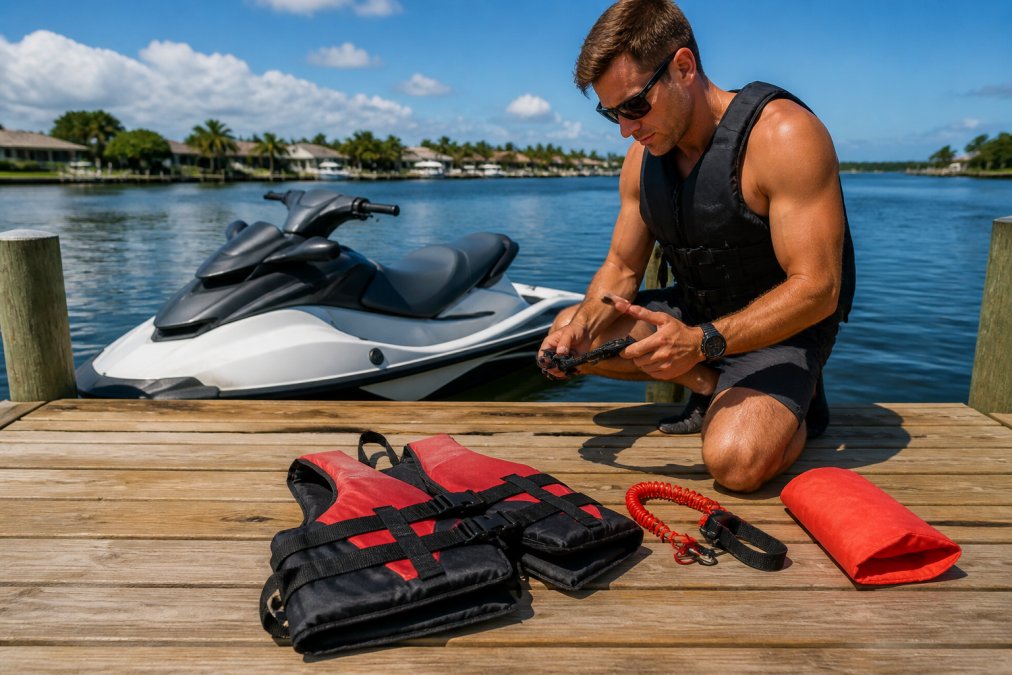
A proper personal flotation device (PFD) or life jacket is your primary defense against drowning. Coast Guard regulations require all personal watercraft operators and passengers wear a Coast Guard-approved PFD at all times while underway (uscg.gov).
The best jet ski life jackets are designed specifically for watersports. Look for a PFD offering at least 15.5 pounds of buoyancy that fits snugly at the shoulders and torso. An oversized jacket will ride up around your neck when you're in the water, defeating its purpose. A quality PFD keeps you afloat even if you're unconscious, which is critical in rough water or after hitting your head during a fall (peer-reviewed research).
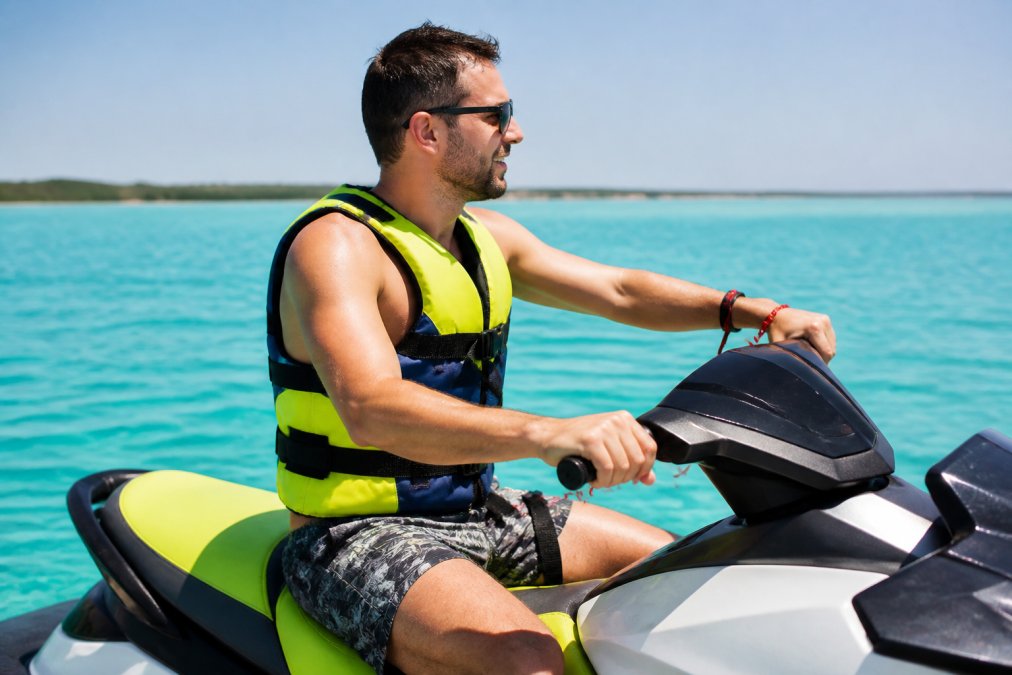
Wear a safety lanyard (kill switch lanyard) that attaches your wrist or ankle to the jet ski's engine shut-off switch. If you fall off, the lanyard pulls the kill switch, stopping the engine immediately. Without it, your jet ski continues running in circles, potentially hitting you or other riders.
Other essential gear includes a helmet (highly recommended though not legally required in most states), water shoes or booties to protect your feet, and a rash guard or wetsuit depending on water temperature.
Pre-Ride Equipment Inspection Checklist
Before starting the engine, perform a thorough pre-departure checklist. This is where many beginners skip steps, and where problems begin.
Visually inspect the hull for cracks, damage, or signs of previous impacts. Check the fuel level and top off if needed. Examine the handlebars for damage and ensure they move freely. Test the throttle by twisting it gently from idle to full acceleration while in neutral on the dock, it should move smoothly without sticking. Check steering by turning the handlebars fully left and right; you should feel resistance but no grinding sounds. Inspect the safety lanyard to ensure it's properly attached to both your wrist and the engine kill switch. Look at the intake area beneath the seat for debris, weeds, or sand.
Here's the pre-ride inspection checklist:
- Visual hull inspection for cracks or damage
- Fuel level adequate and cap secure
- Throttle moves smoothly from idle to full
- Steering turns fully left and right without grinding
- Safety lanyard attached to wrist and kill switch
- Intake grate clear of debris and weeds
- Mirror secure with no cracks
- Seat fasteners tight
- Battery connections clean and secure
- Engine oil level correct
- All warning lights functioning properly
- Drain plugs secure
This process takes 5-10 minutes and can prevent mechanical failures mid-ride.
Understanding Throttle Control and Steering Mechanics
Throttle control is the single most important skill for safe jet ski operation. Unlike a car, a jet ski has no transmission and no engine braking. When you twist the throttle, you directly control the impeller speed, creating forward thrust. When you release the throttle, you coast and gradually slow down.
This means you must anticipate your movements far more than in a car. If you're approaching a no-wake zone or another boat, you can't simply "brake" by releasing the throttle. You need to ease off gradually, well before reaching your destination.
Proper throttle technique starts with a smooth, controlled grip. Don't twist aggressively. Use small, deliberate movements and accelerate gradually, giving yourself time to feel how the jet ski responds. Most beginners over-throttle in the first few minutes, creating unnecessary speed and instability.
When turning, throttle control becomes critical. A jet ski steers by directing thrust from the impeller. Too slow and you won't have enough thrust to turn effectively. Too fast and the jet ski will lean hard, making your body position critical to staying upright. The sweet spot is usually moderate throttle (40-60% power) combined with smooth steering input.
When you turn the handlebars, you move a nozzle that directs water thrust. Your body weight must shift to the inside of the turn to keep the watercraft stable. Too much weight on the outside and you'll flip. Too little on the inside and the jet ski won't lean enough to complete the turn. Practice throttle control in open water before attempting tight turns.
How to Turn a Jet Ski Without Falling: Technique and Practice
Turning requires coordination between your hands, body weight, and throttle control. The fundamental technique is counterintuitive: when you turn a jet ski, lean your body INTO the turn (toward the inside), not away from it. Your upper body should shift toward the handlebars on the side you're turning toward. This lowers your center of gravity on the inside of the turn and prevents the jet ski from rolling.
Here's the step-by-step process for a safe turn:
- Approach at moderate throttle (40-60% power). Slow down before the turn, not during it.
- Look where you want to go, not at the water directly in front of you.
- Lean your upper body inward toward the turn. Shift your weight off the back seat slightly and move your shoulders toward the inside of the curve.
- Turn the handlebars smoothly in the direction you want to go. Avoid jerky movements.
- Maintain throttle or increase slightly once committed to the turn. Releasing throttle mid-turn can cause the jet ski to straighten out unexpectedly.
- Exit the turn by gradually straightening the handlebars and shifting your body weight back to center.
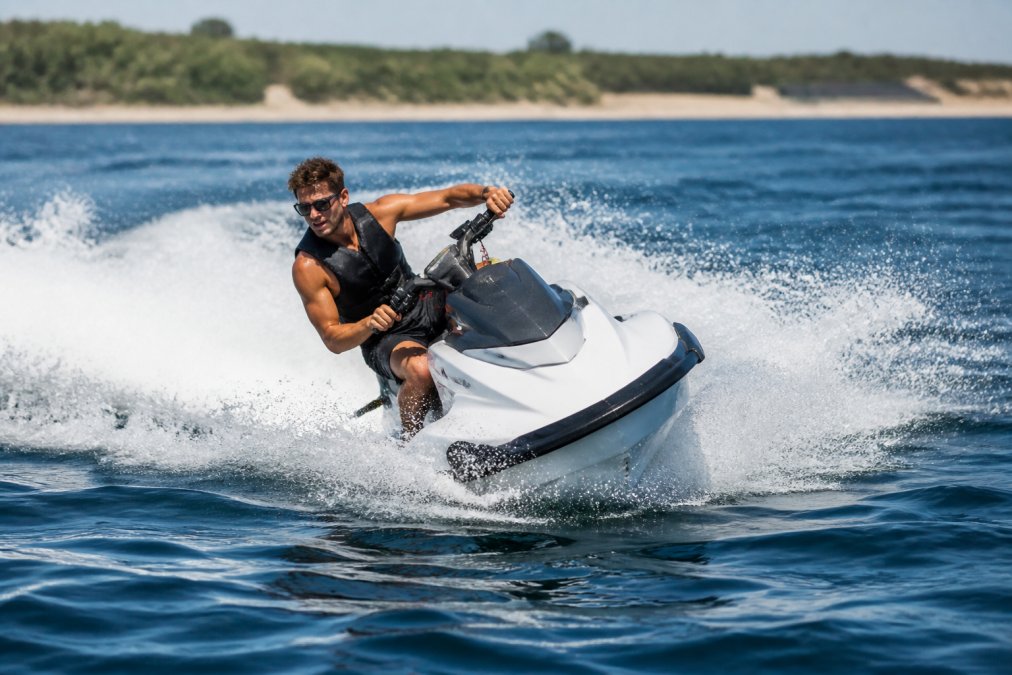
A common mistake is turning the handlebars too hard. A jet ski doesn't need aggressive steering input. Small, controlled movements are far more effective. Practice turning in a large circle at moderate speed. Get comfortable with leaning into the turn and how the jet ski responds to your body position. Gradually tighten your circles as you build confidence. Most falls happen during turns because beginners either don't lean enough or lean too much and slide off the side.
What to Expect From a Jet Ski Rental Safety Briefing
A professional jet ski rental safety briefing should cover equipment operation, local water conditions, navigation rules, and emergency procedures. If your rental facility doesn't provide a thorough briefing, that's a red flag about their commitment to safety.
Book your unforgettable experience today! →
Little Philly Sea Adventures includes a comprehensive safety briefing with every rental. We cover throttle operation, steering mechanics, proper life jacket fit, kill switch usage, and the location of no-wake zones in our service area. We explain right-of-way rules, how to read water conditions, and what to do if you fall off.
A quality safety briefing includes hands-on demonstration. Staff should show you how to mount and dismount the jet ski, start the engine, and properly operate the kill switch. You should receive a map or verbal description of the riding area. Know where no-wake zones are, designated areas where you must operate at idle speed only. Before leaving the dock, confirm you understand all safety procedures. If anything is unclear, ask again.
Water Conditions, Navigation Rules, and Hazard Awareness
Safe jet ski operation depends on understanding water conditions and following navigation rules. Water conditions change throughout the day. Calm morning water can become choppy by afternoon as wind picks up and boat traffic increases. Chop affects your stability and makes the jet ski harder to control. In rough water, slow down and increase your following distance from other boats.
Water depth matters significantly. Shallow water can damage the jet ski's intake if you run over sand or mud. Always maintain awareness of water depth, especially near shore or in unfamiliar areas.
Navigation rules prevent collisions. The basic rule is that jet skis must stay to the right of oncoming traffic, just like cars on a road (uscg.gov). Larger boats have right-of-way over personal watercraft, so if a boat is heading your direction, you need to change course or slow down.
Visibility is critical. Wear bright colors and ensure your jet ski has running lights if riding in low-light conditions. Look ahead for other boats, swimmers, docks, and buoys. Check your mirrors regularly. Listen for engine sounds indicating nearby watercraft. Respect no-wake zones and posted speed limits.
Fall Recovery and Re-Boarding Techniques
Despite your best efforts, you might fall off. Understanding how to recover safely is essential.
If you fall, the first priority is distance. Immediately swim away from the jet ski. Your watercraft is still running, and the propeller can cause serious injury. The kill switch lanyard will stop the engine when you fall, but there's a brief delay. Get clear immediately.
Once at safe distance, assess your condition. Are you injured? Can you swim? If you're injured or unable to swim, stay calm and signal for help. Your life jacket keeps you afloat.
To re-board a jet ski from the water, position yourself at the stern (back) of the watercraft. Here's the proper re-boarding technique:
- Approach from the stern at a 45-degree angle. Never approach from the side where the propeller is located.
- Grab the seat or grab handles with both hands. Get a firm grip before pulling yourself up.
- Pull yourself partially out of the water using your arm strength. Your life jacket will help with buoyancy.
- Swing one leg over the seat while maintaining your grip.
- Slide onto the seat and position yourself for riding. Take a moment to catch your breath and ensure you're stable before restarting.
Re-boarding is physically demanding, especially if you're tired or wearing heavy gear. Practice it in controlled conditions before you need to do it in real situations. If you can't re-board due to injury, exhaustion, or damage, stay with the watercraft and wait for help.
Post-Ride Maintenance and Environmental Responsibility
After your ride, proper maintenance extends the life of the jet ski and ensures it's safe for the next rider. Flush the engine with fresh water after every ride, especially if you've been in saltwater. Saltwater corrodes engine components and intake systems. Inspect the hull for damage after each ride. Small cracks can become major problems if not addressed.
Environmental responsibility matters too. Jet skis produce emissions and can disturb wildlife. Operate at idle speed in shallow areas to minimize bottom disturbance. Avoid riding near nesting birds or marine mammals. Follow all posted environmental regulations in protected areas.
Little Philly Sea Adventures is committed to sustainable practices and environmental stewardship. We maintain our watercraft to minimize emissions and follow all regulations protecting the Gulf Coast ecosystem.
Jet ski riding offers incredible experiences on the water, but it demands respect and preparation. The jet ski safety tips for beginners covered in this guide, from proper gear and equipment inspection to throttle control and fall recovery, form the foundation of safe, confident riding. Take the time to master these fundamentals before pushing your limits. When you're ready to experience the Gulf Coast on a jet ski, Little Philly Sea Adventures provides professional guidance, well-maintained equipment, and the transparent, no-surprises approach you deserve. Book your unforgettable experience today and discover why so many families and adventure seekers trust us for their water activities.
Frequently Asked Questions
What is the most important jet ski safety tip for beginners?
Always wear a Coast Guard-approved personal flotation device (PFD) and attach the safety lanyard to your wrist. The kill switch cuts the engine immediately if you fall off, preventing the jet ski from continuing unmanned. Master throttle control before attempting sharp turns, most beginner accidents happen when riders accelerate too quickly or fail to decelerate before maneuvering. These three habits prevent the majority of common injuries.
What are jet ski life jacket requirements?
Federal law requires all jet ski operators and passengers to wear a Coast Guard-approved Type I, II, or III personal flotation device. A Type III PFD offers good comfort for extended riding. The jacket must fit snugly, allow full arm movement, and have visible reflective strips for visibility on the water. Always inspect your PFD before each ride for tears or degradation, and ensure the safety lanyard connects securely to your wrist.
How do I avoid falling off a jet ski when turning?
To turn a jet ski without falling, reduce throttle before the turn, lean into the direction you're going, and grip the handlebars firmly without tensing your arms. Keep your weight centered and shift your hips slightly outward as the jet ski banks. Practice in open water away from obstacles, starting with gentle turns at low speeds. Never accelerate during a turn, this is when most beginners lose control and fall overboard.
What should I expect during a jet ski rental safety briefing?
A thorough jet ski rental safety briefing covers the kill switch location, throttle and steering mechanics, how to re-board after falling, right-of-way rules, no-wake zone requirements, and emergency procedures. The operator will demonstrate proper PFD fit and explain local navigation rules and water conditions. Ask questions about anything unclear, understanding these basics before departure reduces accidents and ensures you know how to respond if something goes wrong on the water.
This article was written using GrandRanker
Frequently Asked Questions
What is the most important jet ski safety tip for beginners?
Always wear a Coast Guard-approved personal flotation device (PFD) and attach the safety lanyard to your wrist. The kill switch cuts the engine immediately if you fall off, preventing the jet ski from continuing unmanned. Master throttle control before attempting sharp turns—most beginner accidents happen when riders accelerate too quickly or fail to decelerate before maneuvering. These three habits prevent the majority of common injuries.
What are jet ski life jacket requirements?
Federal law requires all jet ski operators and passengers to wear a Coast Guard-approved Type I, II, or III personal flotation device. A Type III PFD offers good comfort for extended riding. The jacket must fit snugly, allow full arm movement, and have visible reflective strips for visibility on the water. Always inspect your PFD before each ride for tears or degradation, and ensure the safety lanyard connects securely to your wrist.
How do I avoid falling off a jet ski when turning?
To turn a jet ski without falling, reduce throttle before the turn, lean into the direction you're going, and grip the handlebars firmly without tensing your arms. Keep your weight centered and shift your hips slightly outward as the jet ski banks. Practice in open water away from obstacles, starting with gentle turns at low speeds. Never accelerate during a turn—this is when most beginners lose control and fall overboard.
What should I expect during a jet ski rental safety briefing?
A thorough jet ski rental safety briefing covers the kill switch location, throttle and steering mechanics, how to re-board after falling, right-of-way rules, no-wake zone requirements, and emergency procedures. The operator will demonstrate proper PFD fit and explain local navigation rules and water conditions. Ask questions about anything unclear—understanding these basics before departure reduces accidents and ensures you know how to respond if something goes wrong on the water.